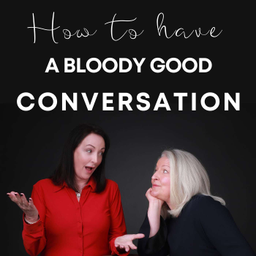
Podcast thumbnail for How to Have a Bloody Good Conversation

How to Have a Bloody Good Conversation

Claim This Podcast

by Sarah Wright & Dr Victoria Stakelum

24 episodes
Updated Weekly
Accepts GuestsHas SponsorsLocation 🇬🇧
22

Podcast Authority

Beta
PoorBased on show quality, social media presence, reviews, charts, and more
Pod Engine
Quality43
Social0
YouTube0
Engagement0

Podcast Overview

If you want to succeed in life, you have to master the art of conversation. From dating to doing business, negotiating a pay rise to haggling over bedtimes, conversations make our world go round. The thing is, most of us were never taught how to have them well. We all learned to talk as toddlers, but mastering conversation that's a different skill entirely, and let’s be honest, most of us are winging it. So if you’ve ever found yourself tongue-tied, lost for words, or dodging a difficult chat, this podcast is for you. Join two curious conversationalists, psychologist and mindset coach Dr Victoria Stakelum and communications consultant Sarah Wright, as we explore how to have a bloody good conversation. It might just change your life.

Language

🇺🇲

Publishing Since

12/12/2024

Unlock The Full Podcast Authority Score Report

See how your podcast performs across key metrics

22

Podcast Authority

Beta
PoorBased on show quality, social media presence, reviews, charts, and more
Pod Engine
Quality43
Social0
YouTube0
Engagement0
5
Excellent Areas
2
Good Performance
12
Growth Opportunities
excellent
Episode Length
58 minutes
Performing excellently!
good
Publishing Consistency
Every 14 days

Recommendations available

Unlock the full report to see detailed tips

needs improvement
Show Notes Quality
2.0/5

Recommendations available

Unlock the full report to see detailed tips

+16 More Metrics

Unlock comprehensive insights including:

  • • YouTube presence analysis
  • • Social media reach metrics
  • • RSS compliance scoring
  • • Podcast 2.0 features
  • • Technical standards
What's Included in Your Full Report

Detailed Analytics

  • Complete breakdown of all 19 authority metrics
  • Personalized recommendations for each metric
  • Industry benchmarks and comparisons
  • Technical RSS feed analysis and compliance scoring

Growth Strategies

  • Step-by-step action plans for improvement
  • Quick wins to boost your score immediately
  • Pro tips from successful podcasters
Get your free podcast insights report

See how your show performs across every key metric

Instant delivery
No spam
Attract Better Guests

High authority scores make your podcast more attractive to industry leaders and influencers who want to appear on credible shows.

Secure Sponsorships

Sponsors look for podcasts with proven authority and engagement. Your score demonstrates your podcast's value to potential partners.

Grow Your Audience

Understanding your strengths and weaknesses helps you make data-driven decisions to expand your listener base effectively.

1 verified contact email on file for How to Have a Bloody Good Conversation

Pitch yourself as a guest, propose sponsorships, or reach out directly to the host.

Recent Episodes

Episode thumbnail for If we're communicating before we say a word, do we dress to impress or express who we are?

June 16, 2026

If we're communicating before we say a word, do we dress to impress or express who we are?

<p>Before you said a single word today, someone had already formed an opinion about your competence, your status, and whether you could be trusted. We've all been told never to judge a book by its cover, and yet researchers tell us we do it anyway, in a fraction of a second, before a handshake, before a hello.</p><p>So what exactly are your clothes saying? And more importantly, is it what you intend?</p><p>In this episode, Sarah Wright and Dr Victoria Stakelum are joined by Stacie Baillie - an ICF-trained coach, leadership advisor, image consultant, certified makeup artist, and founder of Radiant Mirror, who has spent 30 years inside some of the world's largest global organisations watching how the way people show up quietly makes or breaks careers. The conversation covers the secret language of clothing: why 93% of communication is non-verbal and what that means for what you put on in the morning; the sumptuary laws of medieval England (yes, you could be fined for wearing the wrong colour); how the post-Covid collapse of formal dress codes has made the unwritten rules harder to read, not easier; and why a well-fitted jacket can literally change your posture and therefore how the world responds to you.</p><p>Along the way: a Savile Row tailor's verdict on why fit matters more than labels; why King Charles may have worn chalk stripe to the US Senate on purpose; the VP who was being held back not by her work but by her wardrobe; and the single button on a senior woman's blouse that research shows was enough to reduce perceptions of her competence significantly.</p><p>This episode also wrestles with the tensions that sit underneath all of it: between self-expression and conformity, between dressing for yourself and dressing for others, between the freedom to wear what you like and the reality that you will be judged for it regardless. Stacie's closing advice is both practical and kind.</p><p>Part two - what specific items of clothing and colours are actually signalling to the people around you - is coming. But start here.</p><h2>Guest</h2><p>Stacie Baillie: ICF-trained coach, leadership advisor, image consultant, and certified makeup artist. Founder of Radiant Mirror, which offers coaching, leadership development, and influence and image consulting. Stacie spent 30 years working in senior roles at some of the world’s largest global organisations, including banking and consulting, before founding Radiant Mirror to help people bridge the gap between how they see themselves and how the world sees them. You can contact her via her website: <a href="https://www.radiantmirror.ca" target="_blank">www.radiantmirror.ca</a></p><h2>Contact the show</h2><p>Be part of the conversation. If you have a conversational conundrum or a question, please do get in touch via our email: abloodygoodconversation@gmail.com.</p>

Episode thumbnail for The Art of Rapport: How To Build Instant Connection With Anyone

May 7, 2026

The Art of Rapport: How To Build Instant Connection With Anyone

<p>Do you find talking to strangers a challenge? </p><p>You're not alone.</p><p>Researchers at the University of Chicago put commuters on trains and buses and asked some of them to strike up a conversation with the stranger next to them. The ones who did reported significantly happier journeys, every single time. And yet when they asked a separate group beforehand whether they’d enjoy it, almost everyone said no. They predicted feeling awkward or unwanted. They were wrong, but the fear was so convincing, they believed it anyway.</p><p>And yet, for the sake of your health and sanity, you need to find a way to overcome that fear of striking up a conversation and building rapport - connecting - with anyone.</p><p>One in six people worldwide is now affected by loneliness. Around 100 deaths happen every hour as a result. The WHO has declared social connection a public health crisis on a par with obesity and smoking. And yet 75% of us say nothing replaces human connection. We have more ways to reach each other than any generation that has ever lived and we are lonelier than ever.</p><p>In this episode, hosts Sarah Wright and Dr Victoria Stakelum are joined by Anitra Irrera - BBC Radio Kent broadcast journalist, reporter and producer - to explore the art and science of rapport: what it actually is, why we find it so terrifying, and what it takes to build genuine connection with a complete stranger. Anitra has spent her career doing the thing most of us dread - walking up to people she has never met and getting them to open up, whether that’s a grieving family, a hostile politician, or a reluctant celebrity who clearly doesn’t want to be there.</p><p>This episode covers the neuroscience of eye contact, smiling, and mirror neurons; why mirroring someone’s energy and pace builds instant trust (and why this is both a teaching tool in NLP and, some would argue, a dark art); how the fear of rejection is wired into us at a survival level, and how to override it; the Norwegian approach to directness and what the British can learn from it; why digital connection is not the same as the real thing neurologically; and the single most powerful thing you can do to build rapport with anyone, anywhere. Spoiler alert - it involves swearing but not in the way you might think.</p><p>If you’ve ever found yourself staring at your phone to avoid making eye contact on the tube, this one’s for you. Because every person you’ve ever loved was once a stranger. Every single one.</p><h2><span>Guest</span></h2><p><span>Anitra Irrera - BBC Radio Kent broadcast journalist, reporter and producer. Originally from Bergen in Norway, Anitra holds a degree in Psychology and Anthropology and has spent her career building rapport under pressure: from music interviews to political reporting to live broadcasting. She is also a teacher.</span></p><h2><span>Contact</span></h2><p><span>Be part of the conversation. If you have a conversational conundrum or a question, please do get in touch via our email: abloodygoodconversation@gmail.com.</span></p><h2><span>References</span></h2><p><strong>Research mentioned in this episode</strong></p><ul><li>University of Chicago commuter study - Epley &amp; Schroeder (2014), ‘Mistakenly seeking solitude’, Journal of Experimental Psychology: General</li><li>WHO report on loneliness as a global public health priority (2023)</li><li>Mirror neurons and social connection - Rizzolatti &amp; Craighero (2004), Annual Review of Neuroscience</li></ul><p><strong>NLP and rapport</strong></p><ul><li>NLP World — introduction to matching, mirroring and rapport – <a href="https://www.nlpworld.co.uk/" target="_blank">https://www.nlpworld.co.uk</a></li><li>Psychology Today — The Science of Rapport – <a href="https://www.psychologytoday.com/gb/basics/rapport" target="_blank">https://www.psychologytoday.com/gb/basics/rapport</a></li></ul><p><strong>The 100 days of rejection experiment</strong></p><ul><li><strong>Jia Jiang</strong> – ‘Rejection Proof’ TED Talk <a href="https://www.ted.com/talks/jia_jiang_what_i_learned_from_100_days_of_rejection" target="_blank">https://www.ted.com/talks/jia_jiang_what_i_learned_from_100_days_of_rejection</a></li></ul><p><strong>Loneliness and social connection</strong></p><ul><li>WHO — Social isolation and loneliness – <a href="https://www.who.int/teams/mental-health-and-substance-use/promotion-prevention/social-connection" target="_blank">https://www.who.int/teams/mental-health-and-substance-use/promotion-prevention/social-connection</a></li><li>Campaign to End Loneliness (UK) – <a href="https://www.campaigntoendloneliness.org/" target="_blank">https://www.campaigntoendloneliness.org</a></li></ul>

Episode thumbnail for The Conversation You’re Having At 3AM (And How To Change It)

April 7, 2026

The Conversation You’re Having At 3AM (And How To Change It)

<h2>The Conversation You're Having At 3Am (And How To Change It)</h2><p></p><p>You know the one. It starts the moment you wake up at 3am, or maybe it’s the reason you woke up in the first place. Not good enough. Not clever enough. Not doing enough. Most of us are having a conversation with ourselves that we would never tolerate from another person. And it’s doing real damage: to our confidence, our relationships, and for many of us, our sleep.</p><p>In this episode, hosts, Sarah Wright and psychologist Dr Victoria Stakelum, explore why our brains default to negative self-talk, what it is physically doing to our bodies, and what we can do to change it. Victoria explains the science behind negativity bias - the evolutionary survival mechanism that causes the brain to scan for threat and, in the absence of real danger, manufacture it - and why the stories we tell ourselves at night are particularly potent. In a wakeful sleep state, the body can’t tell the difference between a real threat and a vividly imagined one. The catastrophic 3am thought spiral is, quite literally, a self-induced stress response.</p><p>The conversation covers the physiological cost of chronic self-criticism (inflammation, disrupted sleep hormones, reduced immunity), the origins of the inner critic in childhood programming and social comparison, and the research showing that how we speak to ourselves directly shapes what becomes possible for us. Victoria also opens up about her own relationship with perfectionism and all-or-nothing thinking - a reminder that even the psychologist is working on it.</p><p>You’ll come away with a step-by-step process for building kinder self-talk from the ground up: from the one sentence that can de-escalate a 3am spiral, to body scan techniques, to the most powerful reframe of all: responding to yourself as you would to someone you genuinely love.</p><h2>Contact</h2><p>Be part of the conversation. If you have a conversational conundrum or a question, please do get in touch via our email: abloodygoodconversation@gmail.com.</p><h2>References</h2><p><strong>Sarah’s book</strong></p><ul><li><strong>Get Back to Sleep: A Recovering Insomniac’s Practical Guide to Beating Insomnia – </strong><a href="https://amzn.eu/d/08CfTrnd" target="_blank">Available on Amazon</a></li></ul><p></p><p><strong>CBT-I (Cognitive Behavioural Therapy for Insomnia)</strong></p><ul><li>Sarah refers to this course that helped her: <a href="https://re-sleep.com/" target="_blank">ReSleep</a>. </li></ul><p></p><p><strong>Self-talk and self-compassion</strong></p><ul><li>Self-Compassion - Dr Kristin Neff’s research and free self-compassion exercises <a href="https://self-compassion.org" target="_blank">https://self-compassion.org</a></li><li>Psychology Today - What Is Negative Self-Talk, and How Can You Change It? <a href="https://www.psychologytoday.com/gb/basics/self-talk" target="_blank">https://www.psychologytoday.com/gb/basics/self-talk</a></li></ul><p></p><p><strong>Negativity bias</strong></p><ul><li>Verywell Mind - What Is the Negativity Bias? <a href="https://www.verywellmind.com/negative-bias-4589618" target="_blank">https://www.verywellmind.com/negative-bias-4589618</a></li></ul><p></p><p><strong>Mindfulness and body scan</strong></p><ul><li>NHS Every Mind Matters - Mindfulness and body scan audio guides: <a href="https://www.nhs.uk/every-mind-matters/mental-wellbeing-tips/mindfulness/" target="_blank">https://www.nhs.uk/every-mind-matters/mental-wellbeing-tips/mindfulness/</a></li></ul><p></p>

24 total episodes available

Deep-dive analytics for How to Have a Bloody Good Conversation

Frequently asked questions

Have a different question and can't find the answer you're looking for? Reach out to our support team by sending us an email and we'll get back to you as soon as we can.

What is How to Have a Bloody Good Conversation?

If you want to succeed in life, you have to master the art of conversation.

From dating to doing business, negotiating a pay rise to haggling over bedtimes, conversations make our world go round.

The thing is, most of us were never taught how to have them well.

We all learned to talk as toddlers, but mastering conversation that's a different skill entirely, and let’s be honest, most of us are winging it.

So if you’ve ever found yourself tongue-tied, lost for words, or dodging a difficult chat, this podcast is for you.

Join two curious conversationalists, psychologist and mindset coach Dr Victoria Stakelum and communications consultant Sarah Wright, as we explore how to have a bloody good conversation. It might just change your life.

How often does this podcast release new episodes?

This podcast updates weekly.

Where can I listen to this podcast?

This podcast is available on 7 platforms including Apple Podcasts, Spotify, and more. You can also use the RSS feed directly.

Does this podcast accept guests?

No, this podcast does not typically feature guests.

Legal Disclaimer

Pod Engine is not affiliated with, endorsed by, or officially connected with any of the podcasts displayed on this platform. We operate independently as a podcast discovery and analytics service.

All podcast artwork, thumbnails, and content displayed on this page are the property of their respective owners and are protected by applicable copyright laws. This includes, but is not limited to, podcast cover art, episode artwork, show descriptions, episode titles, transcripts, audio snippets, and any other content originating from the podcast creators or their licensors.

We display this content under fair use principles and/or implied license for the purpose of podcast discovery, information, and commentary. We make no claim of ownership over any podcast content, artwork, or related materials shown on this platform. All trademarks, service marks, and trade names are the property of their respective owners.

While we strive to ensure all content usage is properly authorized, if you are a rights holder and believe your content is being used inappropriately or without proper authorization, please contact us immediately at hey@podengine.ai for prompt review and appropriate action, which may include content removal or proper attribution.

By accessing and using this platform, you acknowledge and agree to respect all applicable copyright laws and intellectual property rights of content owners. Any unauthorized reproduction, distribution, or commercial use of the content displayed on this platform is strictly prohibited.