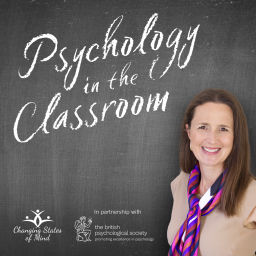
Psychology in the Classroom: bridging the gap between educational science and daily teaching practice. Hosted by Lucinda Powell, the show provides expert insights in education by translating complex educational psychology into actionable, science for educators.
Through high-level education expert interviews, listeners gain access to the latest findings in the science of learning, including evidence-based revision strategies and methods for creating an effective classroom environment. If you are looking for psychological education tools to improve student outcomes, this podcast delivers a mix of theory deep-dives and educational myth busting.
"You matter here": What helps teachers feel valued at work.
...with Dr Ben Looker
Teachers can spend all day surrounded by people and still feel professionally isolated. In this episode Dr Ben Looker, from the University of Worcester, explains why informal peer relationships matter—and how his study of 334 teachers led to a new theory: the "Relational Dynamics of Mattering." He distinguishes feeling that you matter from simply belonging, and explores how trust, recognition, staff culture and even the spaces teachers share shape their relationships. The conversation also reveals how a toxic workplace can push teachers to consider leaving the profession, and what school leaders can do to create better conditions for connection.
The distinctive context of teacher peer relationships in England, including high accountability, workload and limited time for informal interaction.
How teachers' working relationships compare with those in other professions and education systems.
The role of peer relationships in providing practical advice, emotional support and professional connection.
The difference between collegiality, collaboration, belonging and mattering.
The development of the "relational dynamics of mattering" theory through grounded theory research.
How professional culture, leadership, trust and everyday interaction shape whether teachers feel valued and included.
The effects of mattering and "anti-mattering" on teachers' relationships, wellbeing and decisions to remain in teaching.
Ways schools can support positive relationships through recognition, staff voice, professional development, trust and informal spaces.
How negative team climates may spread and influence staff experiences and retention.
The importance of creating the conditions for peer relationships rather than expecting them to develop automatically.
Paper 'The social and emotional dynamics of teachers' peer relationships': https://www.frontiersin.org/journals/education/articles/10.3389/feduc.2026.1907631/full
Resources:https://www.worcester.ac.uk/about/academic-schools/school-of-education/education-research/psychology-of-education/social-contracts-research-impact.aspx
Previous episode: The Pupil-Teacher Relationship with Dr Ben Looker: https://changingstatesofmind.libsyn.com/the-pupil-teacher-relationship-with-dr-ben-looker
15 Sept 2026
Addressing the Mental Health Crisis in Schools: Challenges, Solutions, and the Road Ahead
…With Amy Sayer
Amy Sayer is a mental health and neurodiversity consultant and former secondary school senior leader. This episode discusses the growing mental health crisis among young people, highlighting challenges in accessing CAMHS support, with only 36% of referrals receiving help. Amy emphasises schools' critical role in supporting student wellbeing, advocating for both a meaningful mental health curriculum and a positive whole-school culture. Amy also addresses staff wellbeing, inclusivity for neurodivergent students, and funding gaps. The conversation centres on her book, How to Build a Meaningful Mental Health Curriculum: A Practical Guide for Schools, offering practical support for educators.
Amy's Book - How to Build a Meaningful Mental Health Curriculum: A Practical Guide for Schools: https://www.sagepub.com/shop/buy-a-book/how-to-build-a-meaningful-mental-health-curriculum-1-292569
Amy's Website: https://amy-sayer.com/
Hub of Hope: https://hubofhope.co.uk/
Episode with Reinhard Pekrun: https://changingstatesofmind.libsyn.com/exploring-the-complex-role-of-emotions-in-student-motivation-performance-and-well-being
Episode in bullet points:
Amy Sayer's background in education and mental health leadership.
Overview of her book, "How to Build a Meaningful Mental Health Curriculum: A Practical Guide for Schools."
Current state of young people's mental health and challenges in accessing services like CAMHS.
Societal factors contributing to mental health issues among youth, including poverty and social media.
The role of schools and teachers in supporting mental health, especially when external services are limited.
Importance of staff mental health and creating a supportive school environment.
Strategies for developing a positive mental health culture in schools.
The need for an inclusive mental health curriculum that addresses diverse student needs.
Systemic barriers to delivering effective mental health support in educational settings.
The significance of funding for mental health training and resources in schools.
9 Sept 2026
Exploring the Complex Role of Emotions in Student Motivation, Performance, and Well-Being
…with Professor Reinhard Pekrun
In this episode, Professor Reinhard Pekrun discusses the critical role emotions play in academic settings. Drawing on his Control-Value Theory, he explains how emotions influence students' learning, motivation, and well-being. Pekrun challenges the oversimplified view that positive emotions always help and negative ones always hinder learning, emphasising context and intensity as key factors. He also highlights teachers' emotional impact on students and outlines six instructional strategies to foster positive emotional experiences. The episode concludes with practical insights for educators on supporting students' emotional health while maintaining their own enthusiasm and avoiding burnout.
Links:
Reinhard Pekrun: https://www.essex.ac.uk/people/PEKRU37203/Reinhard-Pekrun
Book: Emotion in Education. by Paul Schutz (Editor), Reinhard Pekrun (Editor), Gary D. Phye (Series Editor): https://www.amazon.co.uk/Emotion-Education-Educational-Psychology/dp/0123725453
Emotions in Learning, Unesco: https://unesdoc.unesco.org/ark:/48223/pf0000227679
Episode in Bullet points:
The role of emotions in education and their impact on learning and academic performance.
The relationship between students' emotional states and their motivation, self-regulation, and engagement.
The categorization of emotions into positive and negative, and their effects on learning outcomes.
The significance of context, intensity, and task demands in understanding emotional impacts on students.
The historical focus of educational research on cognitive processes, with a recent shift towards recognizing the importance of emotions.
Who has been a guest on Psychology in the Classroom
Names identified in recent episode analyses. Showing up to five guests.
Prof Jess Deighton
Harriet Ennis
Dr Lauren Margulieux
Dr Andrew Holliman
Dr Carolina Guzman Holst
Reach and audience
Public platform figures. Ratings count people who left a rating, not total listeners.
YouTube views
587
Score snapshot 15 Sept 2025
Apple Podcasts (US)
5.0 / 5
3 ratings
Spotify
5.0 / 5
22 ratings
Podcast Authority Score: 89 / 100
A composite of feed quality, social presence, YouTube performance and engagement. Read the methodology.
Quality
96
Social presence
91
YouTube
64
Engagement
92
Contact Psychology in the Classroom
Guest appearances
Books guests
Based on episode analysis; this does not confirm that the show is currently accepting guests.
Pod Engine is an independent podcast discovery and analytics service and is not affiliated with or endorsed by this podcast. Artwork and show content belong to their owners. Full legal notice.
Explore this show Podcast research with Pod Engine