
Works of classical repertoire often exhibit complexity in their use of orchestration, counterpoint, harmony, musical development, rhythm, phrasing, texture, and form. Whereas most popular styles are usually written in song form, classical music is noted for its development of highly sophisticated instrumental musical forms, like the concerto, symphony and sonata. Classical music is also noted for its use of sophisticated vocal/instrumental forms, such as opera. In opera, vocal soloists and choirs perform staged dramatic works with an orchestra providing accompaniment.<br /><br />Longer instrumental works are often divided into self-contained pieces, called movements, often with contrasting characters or moods. For instance, symphonies written during the Classical period are usually divided into four movements:<br /><br />( 1) An opening Allegro in sonata form, a slow movement,<br />a minuet or scherzo (in a triple metre, such as 3<br />4), and a final Allegro.<br />These movements can then be further broken down into a hierarchy of smaller units: first sections, then periods, and finally phrases.<br /><br />Performers who have studied classical music extensively are said to be "classically trained". This training may come from private lessons from instrument or voice teachers or from completion of a formal program offered by a Conservatory, college or university, such as a Bachelor of Music or Master of Music degree (which includes individual lessons from professors). In classical music, "...extensive formal music education and training, often to postgraduate [Master's degree] level" is required.<br /><br />Performance of classical music repertoire requires a proficiency in sight-reading and ensemble playing, harmonic principles, strong ear training (to correct and adjust pitches by ear), knowledge of performance practice (e.g., Baroque ornamentation), and a familiarity with the style/musical idiom expected for a given composer or musical work (e.g., a Brahms symphony or a Mozart concerto).<br /><br />The key characteristic of European classical music that distinguishes it from popular music and folk music is that the repertoire tends to be written down in musical notation, creating a musical part or score. This score typically determines details of rhythm, pitch, and, where two or more musicians (whether singers or instrumentalists) are involved, how the various parts are coordinated. The written quality of the music has enabled a high level of complexity within them: fugues, for instance, achieve a remarkable marriage of boldly distinctive melodic lines weaving in counterpoint yet creating a coherent harmonic logic.<br /><br />The use of written notation also preserves a record of the works and enables Classical musicians to perform music from many centuries ago.<br /><br />Although Classical music in the 2000s has lost most of its tradition for musical improvisation, from the Baroque era to the Romantic era, there are examples of performers who could improvise in the style of their era. In the Baroque era, organ performers would improvise preludes, keyboard performers playing harpsichord would improvise chords from the figured bass symbols beneath the bass notes of the basso continuo part and both vocal and instrumental performers would improvise musical ornaments.<br /><br />Johann Sebastian Bach was particularly noted for his complex improvisations. During the Classical era, the composer-performer Mozart was noted for his ability to improvise melodies in different styles. During the Classical era, some virtuoso soloists would improvise the cadenza sections of a concerto. During the Romantic era, Beethoven would improvise at the piano.<br /><br /><br />classical music ,classical music news ,classicalmusicworldusic youtube ,classical music composers ,classical music radio ,music history ,classicalmusic lover ,classicalmusicblog ,classical music downloads ,classical music concerts ,classical music for babies ,classical music for studying ,classical music for kids ,classical music online ,classical music of...<hr><p style='color:grey; font-size:0.75em;'> Hosted on Acast. See <a style='color:grey;' target='_blank' rel='noopener noreferrer' href='https://acast.com/privacy'>acast.com/privacy</a> for more information.</p>
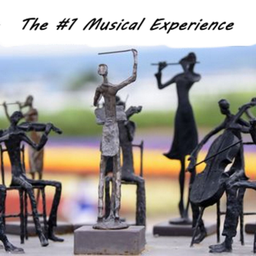
The #1 Musical Experience
Claim This Podcastby Herb Williams
Podcast Overview
Works of classical repertoire often exhibit complexity in their use of orchestration, counterpoint, harmony, musical development, rhythm, phrasing, texture, and form. Whereas most popular styles are usually written in song form, classical music is noted for its development of highly sophisticated instrumental musical forms, like the concerto, symphony and sonata. Classical music is also noted for its use of sophisticated vocal/instrumental forms, such as opera. In opera, vocal soloists and choirs perform staged dramatic works with an orchestra providing accompaniment.<br /><br />Longer instrumental works are often divided into self-contained pieces, called movements, often with contrasting characters or moods. For instance, symphonies written during the Classical period are usually divided into four movements:<br /><br />( 1) An opening Allegro in sonata form, a slow movement,<br />a minuet or scherzo (in a triple metre, such as 3<br />4), and a final Allegro.<br />These movements can then be further broken down into a hierarchy of smaller units: first sections, then periods, and finally phrases.<br /><br />Performers who have studied classical music extensively are said to be "classically trained". This training may come from private lessons from instrument or voice teachers or from completion of a formal program offered by a Conservatory, college or university, such as a Bachelor of Music or Master of Music degree (which includes individual lessons from professors). In classical music, "...extensive formal music education and training, often to postgraduate [Master's degree] level" is required.<br /><br />Performance of classical music repertoire requires a proficiency in sight-reading and ensemble playing, harmonic principles, strong ear training (to correct and adjust pitches by ear), knowledge of performance practice (e.g., Baroque ornamentation), and a familiarity with the style/musical idiom expected for a given composer or musical work (e.g., a Brahms symphony or a Mozart concerto).<br /><br />The key characteristic of European classical music that distinguishes it from popular music and folk music is that the repertoire tends to be written down in musical notation, creating a musical part or score. This score typically determines details of rhythm, pitch, and, where two or more musicians (whether singers or instrumentalists) are involved, how the various parts are coordinated. The written quality of the music has enabled a high level of complexity within them: fugues, for instance, achieve a remarkable marriage of boldly distinctive melodic lines weaving in counterpoint yet creating a coherent harmonic logic.<br /><br />The use of written notation also preserves a record of the works and enables Classical musicians to perform music from many centuries ago.<br /><br />Although Classical music in the 2000s has lost most of its tradition for musical improvisation, from the Baroque era to the Romantic era, there are examples of performers who could improvise in the style of their era. In the Baroque era, organ performers would improvise preludes, keyboard performers playing harpsichord would improvise chords from the figured bass symbols beneath the bass notes of the basso continuo part and both vocal and instrumental performers would improvise musical ornaments.<br /><br />Johann Sebastian Bach was particularly noted for his complex improvisations. During the Classical era, the composer-performer Mozart was noted for his ability to improvise melodies in different styles. During the Classical era, some virtuoso soloists would improvise the cadenza sections of a concerto. During the Romantic era, Beethoven would improvise at the piano.<br /><br /><br />classical music ,classical music news ,classicalmusicworldusic youtube ,classical music composers ,classical music radio ,music history ,classicalmusic lover ,classicalmusicblog ,classical music downloads ,classical music concerts ,classical music for babies ,classical music for studying ,classical music for kids ,classical music online ,classical music of...<hr><p style='color:grey; font-size:0.75em;'> Hosted on Acast. See <a style='color:grey;' target='_blank' rel='noopener noreferrer' href='https://acast.com/privacy'>acast.com/privacy</a> for more information.</p>
Language
🇺🇲
Publishing Since
12/24/2019
1 verified contact email on file for The #1 Musical Experience
Pitch yourself as a guest, propose sponsorships, or reach out directly to the host.
Recent Episodes
October 14, 2022
Jazz Love-Romantic
As jazz spread around the world, it drew on national, regional, and local musical cultures, which gave rise to different styles. New Orleans jazz began in the early 1910s, combining earlier brass band marches, French quadrilles, biguine, ragtime and blues with collective polyphonic improvisation. But jazz did not begin as a single musical tradition in New Orleans or elsewhere. In the 1930s, arranged dance-oriented swing big bands, Kansas City jazz (a hard-swinging, bluesy, improvisational style), and gypsy jazz (a style that emphasized musette waltzes) were the prominent styles. Bebop emerged in the 1940s, shifting jazz from danceable popular music toward a more challenging "musician's music" which was played at faster tempos and used more chord-based improvisation. Cool jazz developed near the end of the 1940s, introducing calmer, smoother sounds and long, linear melodic lines.<hr><p style='color:grey; font-size:0.75em;'> Hosted on Acast. See <a style='color:grey;' target='_blank' rel='noopener noreferrer' href='https://acast.com/privacy'>acast.com/privacy</a> for more information.</p>
September 8, 2022
I - Allegro Schubert String Quintet
Schubert String Quintet, D. 956<br /><br />The String Quintet in C major, D. 956 - and often referred to as Op. posth. 163- was Franz Schubert's final chamber work. It is a cello quintet, in the sense that it is scored for a standard string quartet lineup plus an additional cello -with the viola being by far the most common choice. The work has been described as a chamber music masterpiece, and since its public performance in 1850 and its publication in 1853, it has gained status as one of Schubert's finest works.<hr><p style='color:grey; font-size:0.75em;'> Hosted on Acast. See <a style='color:grey;' target='_blank' rel='noopener noreferrer' href='https://acast.com/privacy'>acast.com/privacy</a> for more information.</p>
August 15, 2022
Mozart Requiem in D minor,
Requiem in D minor, K. 626 - VI. Benedictus Wolfgang Amadeus Mozart started composing the Requiem Mass in D minor (K. 626) in Vienna in 1791, following an anonymous commision from Count Franz von Walsegg, who requested the piece to commemorate the anniversary of his wife's death. Mozart passed away on December of 1791, however, having finished and orchestrated only one movement. The Requiem is widely considered one of Mozart's greatest works, and its composition process is surrounded a shroud of mistery and myths, usually attributed to Mozart's wife Constanze, who had to keep secret the fact that Mozart hadn't completed the work in order to be able to collect the final payment from the commision. It is commonly accepted that Mozart finished the Introitus, and left detailed sketches of the Kyrie and Dies Irae all the way to the first eight bars of the Lacrimosa and parts of the Offertory. There are now several completions of the Requiem Mass, though the most common by far (considered the standard version of the piece) is the one by Franz Xaver Süssmayr. He not only completed the movements Mozart left (borrowing an unespecified amount from Joseph von Eybler's previous attemps at completing the work) but also added several movements of his own: Sanctus, Benedictus, and Agnus Dei. He then added a final section, Lux aeterna by adapting the opening two movements which Mozart had written to the different words which finish the Requiem Mass. The myth surrounding this work was increased by the fictional rivarly between Mozart and Antonio Salieri first expressed in 'Mozart and Salieri', a play by Alexander Pushkin, which in turn inspired an opera by Rismky Korsakov of the same name, the inmensely popular 1979 play 'Amadeus', by Peter Shaffer, and it's 1984 film adaptation by Miloš Forman. The Requiem is scored for 2 basset horns in F, 2 bassoons, 2 trumpets in D, 3 trombones (alto, tenor & bass), timpani (2 drums), violins, viola, and basso continuo (cello, double bass, and organ). The vocal forces include soprano, contralto, tenor, bass soloists, and an SATB mixed choir.<hr><p style='color:grey; font-size:0.75em;'> Hosted on Acast. See <a style='color:grey;' target='_blank' rel='noopener noreferrer' href='https://acast.com/privacy'>acast.com/privacy</a> for more information.</p>
130 total episodes available
Similar Podcasts
Discover related shows you might enjoy
Sleep & Relaxation Music to Calm the Nervous System
SOMA Sound

Sleep Sounds Meditation for Women
Sleep Sounds

Sleep - Meandering Piano
Meandering Piano

Sleep Magic - Sleep Hypnosis & Meditations
Sleepiest: Hypnosis for Sleep Podcast

The Rest Is Politics: US
Goalhanger

Uncanny
BBC Radio 4

Classical Music Free
Unknown author

The Holy Rosary
Creedal

Classical Performance
Classical Performance

48 Hours
CBS News

Passages
Louie Media

null Sample
A&E / PodcastOne

Sleep Better | Sleep Music with Noise
Sleep Better

SmartLess
Jason Bateman, Sean Hayes, Will Arnett

Fresh Air
NPR
Deep-dive analytics for The #1 Musical Experience
Frequently asked questions
Have a different question and can't find the answer you're looking for? Reach out to our support team by sending us an email and we'll get back to you as soon as we can.
- What is The #1 Musical Experience?
- How often does this podcast release new episodes?
This podcast updates daily.
- Where can I listen to this podcast?
This podcast is available on 4 platforms including Apple Podcasts, Spotify, and more. You can also use the RSS feed directly.
- Does this podcast accept guests?
No, this podcast does not typically feature guests.
Legal Disclaimer
Pod Engine is not affiliated with, endorsed by, or officially connected with any of the podcasts displayed on this platform. We operate independently as a podcast discovery and analytics service.
All podcast artwork, thumbnails, and content displayed on this page are the property of their respective owners and are protected by applicable copyright laws. This includes, but is not limited to, podcast cover art, episode artwork, show descriptions, episode titles, transcripts, audio snippets, and any other content originating from the podcast creators or their licensors.
We display this content under fair use principles and/or implied license for the purpose of podcast discovery, information, and commentary. We make no claim of ownership over any podcast content, artwork, or related materials shown on this platform. All trademarks, service marks, and trade names are the property of their respective owners.
While we strive to ensure all content usage is properly authorized, if you are a rights holder and believe your content is being used inappropriately or without proper authorization, please contact us immediately at hey@podengine.ai for prompt review and appropriate action, which may include content removal or proper attribution.
By accessing and using this platform, you acknowledge and agree to respect all applicable copyright laws and intellectual property rights of content owners. Any unauthorized reproduction, distribution, or commercial use of the content displayed on this platform is strictly prohibited.