
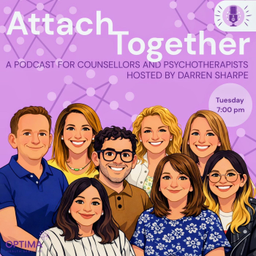
Attach Together
Claim This Podcastby Optima Health Services
Podcast Overview
<p>Attached Together is a podcast exploring <b>attachment theory</b>, attachment styles, and psychotherapy in clinical practice.</p><p>Created by the therapists and tutors at Optima Health Services, this podcast is for counsellors, psychotherapists, and mental health professionals who want grounded, thoughtful conversations about attachment, trauma, relationships, and everyday therapeutic work.</p><p>Each episode examines how attachment shapes the way we love, cope, regulate, and connect - both in our personal lives and in the therapy room. Expect practical insights, reflective discussion, and training-level knowledge that bridges theory and practice without unnecessary jargon.</p><p>Listeners can also receive a <b>CPD certificate</b> for each episode, making it easy to integrate ongoing professional development into your week while deepening your understanding of attachment-informed practice.</p><p>Whether you’re working with anxious, avoidant, or disorganised attachment, supporting couples, or strengthening your clinical formulation skills, Attached Together offers thoughtful, experience-based conversations rooted in real therapeutic work.</p>
Language
🇺🇲
Publishing Since
2/22/2026
1 verified contact email on file for Attach Together
Pitch yourself as a guest, propose sponsorships, or reach out directly to the host.
Recent Episodes
July 13, 2026
Attachment and Creative Approaches in Therapy: Working Beyond Words
<p><a rel="noopener noreferrer nofollow" href="https://api.leadconnectorhq.com/widget/form/4m6wB1KJnv1hsGVeBGPm" target="_blank">CPD Certificate </a></p><p>In this episode, Georgina Sturmer and Darren look at creativity through the lens of <b>attachment theory</b>, asking how play, metaphor and objects can open up the work without overwhelming the client.</p><p>Creative work is much broader than drawing or painting. A game of Uno, a collection of stones, visual cards, nesting dolls or a shared metaphor may give a client another way to show us something about their internal world.</p><p><b>Creative approaches in therapy use play, imagery, metaphor, sensory experience or physical objects to support emotional exploration and communication.</b></p><p>For some clients, talking can feel pressured. They may worry about saying the wrong thing, getting their story right or naming an emotion accurately. Creative work can sometimes soften that pressure and bring us closer to felt experience.</p><h2>In this episode, we explore:</h2><ul><li>Creativity beyond pens, paper and paint</li><li>Play, the inner child and pre-verbal experience</li><li>Using games to support connection</li><li>Stones, visual cards and sand tray work</li><li>Shame and the fear of getting creativity “wrong”</li><li>Avoidant attachment and creative work</li><li>Drawing with the non-dominant hand</li><li>Noticing rather than interpreting</li><li>Nesting dolls and attachment metaphors</li><li>Creative approaches in online therapy</li><li>The swimming pool metaphor</li><li>Creativity in supervision</li><li>Therapist enthusiasm, pacing and relational safety</li></ul><h2>Creativity and Attachment-Informed Therapy</h2><p>A client’s response to creativity can tell us something about the process between us.</p><p>Some clients may engage quickly. Others may become hesitant, embarrassed or self-critical. For clients with more avoidant attachment tendencies, creative work may initially feel unfamiliar or exposing.</p><p>The task is not to push through that hesitation.</p><p>It is to notice it.</p><p>Creative work can be useful when a client feels stuck, struggles to find language or seems unsure how to use the therapy space. But the intervention should remain in service of the client, rather than the therapist’s enthusiasm for a particular approach.</p><h2>Common Questions</h2><h3>What are creative approaches in therapy?</h3><p>Creative approaches in therapy use play, metaphor, images, sensory materials or objects to help clients explore emotional and relational experiences.</p><h3>How can creativity support attachment-informed therapy?</h3><p>It can offer another route into attachment trauma, attachment styles and relationships, particularly when direct emotional language feels difficult.</p><h3>Are creative approaches only for children?</h3><p>No. Adults may also find play, metaphor and sensory work helpful, especially when experiences feel difficult to explain verbally.</p><h3>Can creative approaches be used online?</h3><p>Yes. Therapists can use drawings, objects, visual metaphors and shared imagery in online therapy as well as face-to-face work.</p><h2>YouTube Chapters</h2><p>00:00 Welcome to Season Two<br />00:55 Creativity in the therapy room<br />01:31 What is a creative approach?<br />04:09 Stones and visualising the client’s world<br />06:47 Choosing a creative intervention<br />09:05 Sand tray and sensory experience<br />09:48 Attachment styles and creativity<br />10:58 The wardrobe drawing exercise<br />13:51 Nesting dolls in therapy<br />16:59 Creative work online<br />18:56 Castles, bridges and defensive strategies<br />20:06 Creativity in supervision<br />21:34 Keeping the client at the centre</p><p></p><p>For more conversations about <b>attachment theory, attachment styles, attachment trauma, attachment-informed therapy and relationships</b>, subscribe to <i>Attached Together</i> </p>
June 9, 2026
Attachment Parenting Repair, Good Enough Parenting & the Pressure to Get It Right
<p>This bonus episode of <i>Attach Together</i> feels different from our usual conversations.</p><p>Kiah, who edits the podcast and works alongside Darren and the Optima team, joins not as a clinical host, but as a parent of two young children. After listening back to previous episodes, she brings a question many parents may quietly recognise:</p><p><i>Am I getting this wrong?</i></p><p>Together, Kiah and Darren explore <b>attachment theory</b>, <b>attachment styles</b>, <b>relationships</b>, and <b>therapy</b> through the everyday realities of parenting: screen time, guilt, tiredness, dinner-time battles, social media pressure, and the hope that repair may matter more than perfection.</p><p><b>Attachment parenting repair means noticing when something has gone wrong between parent and child, and finding a way back into connection.</b></p><p>The episode returns to the idea of “good enough” parenting. Children do not need perfect attunement all the time. They need enough moments of being seen, soothed, enjoyed and returned to.</p><p>For counsellors, psychotherapists, psychologists and therapy trainees, this conversation also asks something important: when we talk about attachment-informed practice, does our language help parents feel more reflective, or more ashamed?</p><h2>In this episode</h2><p>Kiah and Darren reflect on:</p><ul><li>why attachment theory can feel overwhelming for parents</li><li>the difference between repair and perfection</li><li>how parents may repeat, reject or overcorrect from their own childhoods</li><li>screen time, smartphones and guilt</li><li>the “perfect parent” image on social media</li><li>the ABC model: antecedent, behaviour and consequence</li><li>why therapists may over-analyse their own parenting</li><li>how small moments of play and repair build safety over time</li></ul><h2>Common questions</h2><h3>What is attachment parenting repair?</h3><p>Attachment parenting repair is the process of returning to connection after a difficult or misattuned moment. It may involve apology, humour, touch, explanation, play, or simply coming back with warmth.</p><h3>Does attachment theory mean parents must get everything right?</h3><p>No. Attachment theory does not ask parents to be perfect. Repair after rupture is part of how children learn that relationships can survive difficulty.</p><h3>How do attachment styles affect parenting?</h3><p>A parent’s attachment style may shape how they respond to crying, closeness, conflict, independence or overwhelm. Becoming aware of those patterns can make parenting more conscious.</p><h2>YouTube chapters</h2><p>01:02 Good enough parenting<br />02:33 Attunement, rupture and repair<br />07:46 Wondering about attachment style<br />10:24 Screen time and parenting pressure<br />13:21 Social media and external authority<br />21:20 Brain development, play and connection<br />28:50 Repairing difficult parenting moments<br />32:15 Do therapists over-analyse parenting?<br />36:06 The ABC model of behaviour<br />38:15 Dinnertime struggles<br />41:40 Changing antecedents and consequences</p><h2>Resources mentioned</h2><ul><li>Winnicott’s idea of the “good enough” mother</li><li>Kate Silverton, <i>There’s No Such Thing as Naughty</i></li><li>Kate Silverton, <i>Still No Such Thing as Naughty</i></li><li>ABC model: antecedent, behaviour and consequence</li><li>Optima Level 5 and Level 7 Diplomas in attachment-based psychotherapy</li></ul><p>A CPD certificate link is available in the show notes. You may also use this episode for personal reflection, supervision or CPD learning.</p>
May 1, 2026
Mindfulness Burnout Prevention for Therapists
<p>Mindfulness burnout prevention helps therapists, counsellors and psychologists notice early signs of exhaustion, emotional fatigue and professional disconnection before burnout becomes entrenched.</p><p>In this bonus episode of <i>Attach Together</i>, Darren speaks with <b>Christopher Dines</b>, author, mindfulness practitioner, coach and former DJ, about <b>MBP: Mindfulness Burnout Prevention</b>. Christopher has published eight books on mindfulness and addiction, including <i>The Kindness Habit</i>, co-authored with Dr Barbara Mariposa.</p><p>This conversation explores how mindfulness burnout prevention supports mental health professionals at risk of burnout, isolation and emotional depletion. Rather than simply focusing on meditation, MBP encourages awareness of thoughts, emotions, bodily sensations, lifestyle, relational needs and professional limits.</p><p>For attachment-informed practitioners, this matters deeply. Therapists often become a secure base for others, yet may struggle to notice when their own capacity is becoming depleted.</p><p></p><p>🔎 <b>What You’ll Learn</b></p><ul><li>What mindfulness burnout prevention means</li><li>Early warning signs of therapist burnout</li><li>The difference between tiredness, exhaustion and burnout</li><li>Why therapists can feel isolated in modern practice</li><li>How online therapy has changed professional connection</li><li>Why community helps prevent emotional depletion</li><li>How mindfulness creates space, clarity and regulation</li><li>Why asking for help is a professional strength</li></ul><p><b>Common Search Questions</b></p><p><b>What is mindfulness burnout prevention?</b><br />Mindfulness burnout prevention uses awareness, reflection and supportive community to help therapists notice and respond to early signs of professional fatigue.</p><p><b>How does burnout affect therapists?</b><br />Burnout can lead to exhaustion, apathy, resentment, reduced empathy, isolation and feeling disconnected from clinical work.</p><p><b>Why is community important for therapists?</b><br />Community offers therapists connection, reflection and support from others who understand the emotional demands of the work.</p><p><b>How does mindfulness help prevent burnout?</b><br />Mindfulness helps practitioners notice stress, bodily tension, emotional withdrawal and reduced capacity earlier, supporting better boundaries and self-care.</p><h2>🕑Chapters</h2><p>00:00 Welcome to this bonus episode<br />01:25 What is MBP?<br />02:25 Christopher’s recovery journey and mindfulness practice<br />05:54 When mindfulness became more widely recognised<br />07:07 How MBP developed for therapists and psychologists<br />09:21 Warning signs of burnout<br />11:15 What support can look like<br />12:51 The emotional demands of therapy work<br />14:02 Online therapy, isolation and the shrinking gap between work and life<br />15:59 Key takeaways: asking for help and finding community<br />17:20 Bonus reflection on retreats, group meditation and practitioner support</p><h2>Resources Mentioned</h2><ul><li>Mindfulness Burnout Prevention: <a rel="noopener noreferrer nofollow" href="http://mindfulnessburnoutprevention.com" target="_blank">mindfulnessburnoutprevention.com</a></li><li>Christopher Dines’ books on mindfulness and addiction</li><li><i>The Kindness Habit</i> by Christopher Dines and Dr Barbara Mariposa</li><li>Optima Health Services CPD certificate and reflection pack</li><li>Optima therapist retreat with Darren, Jo and guest speaker Linda Cundy</li></ul><h2>FREE CPD Certificate & Reflection Pack</h2><p>You can download the <b>FREE CPD Certificate </b>for this episode via our website <a rel="noopener noreferrer nofollow" href="http://www.optimahealthservices.co.uk" target="_blank"><b>www.optimahealthservices.co.uk</b></a> and join our listener list to receive the<b> Reflection Pack </b>for future episodes.</p>
14 total episodes available
Similar Podcasts
Discover related shows you might enjoy

Complex with Kimberley Wilson
BBC Sounds

Begin Again with Davina McCall
Begin Again

Sh**ged Married Annoyed
Chris & Rosie Ramsey
Family Flowers Only by Grief Ireland
GoLoud

The Rest Is Politics
Goalhanger

The Rest Is Politics: US
Goalhanger

Where Should We Begin? with Esther Perel
Esther Perel Global Media

This Jungian Life Podcast
Joseph Lee, Deborah Stewart, Lisa Marchiano

I Wish You Knew
Adam Lane Smith & Andrey Korikov

The Mel Robbins Podcast
Mel Robbins
Psychotherapy Central
Jennifer Nurick
Deep-dive analytics for Attach Together
Frequently asked questions
Have a different question and can't find the answer you're looking for? Reach out to our support team by sending us an email and we'll get back to you as soon as we can.
- What is Attach Together?
<p>Attached Together is a podcast exploring <b>attachment theory</b>, attachment styles, and psychotherapy in clinical practice.</p><p>Created by the therapists and tutors at Optima Health Services, this podcast is for counsellors, psychotherapists, and mental health professionals who want grounded, thoughtful conversations about attachment, trauma, relationships, and everyday therapeutic work.</p><p>Each episode examines how attachment shapes the way we love, cope, regulate, and connect - both in our personal lives and in the therapy room. Expect practical insights, reflective discussion, and training-level knowledge that bridges theory and practice without unnecessary jargon.</p><p>Listeners can also receive a <b>CPD certificate</b> for each episode, making it easy to integrate ongoing professional development into your week while deepening your understanding of attachment-informed practice.</p><p>Whether you’re working with anxious, avoidant, or disorganised attachment, supporting couples, or strengthening your clinical formulation skills, Attached Together offers thoughtful, experience-based conversations rooted in real therapeutic work.</p> - How often does this podcast release new episodes?
This podcast updates daily.
- Where can I listen to this podcast?
This podcast is available on 4 platforms including Apple Podcasts, Spotify, and more. You can also use the RSS feed directly.
- Does this podcast accept guests?
Yes, this podcast regularly features guests.
Legal Disclaimer
Pod Engine is not affiliated with, endorsed by, or officially connected with any of the podcasts displayed on this platform. We operate independently as a podcast discovery and analytics service.
All podcast artwork, thumbnails, and content displayed on this page are the property of their respective owners and are protected by applicable copyright laws. This includes, but is not limited to, podcast cover art, episode artwork, show descriptions, episode titles, transcripts, audio snippets, and any other content originating from the podcast creators or their licensors.
We display this content under fair use principles and/or implied license for the purpose of podcast discovery, information, and commentary. We make no claim of ownership over any podcast content, artwork, or related materials shown on this platform. All trademarks, service marks, and trade names are the property of their respective owners.
While we strive to ensure all content usage is properly authorized, if you are a rights holder and believe your content is being used inappropriately or without proper authorization, please contact us immediately at hey@podengine.ai for prompt review and appropriate action, which may include content removal or proper attribution.
By accessing and using this platform, you acknowledge and agree to respect all applicable copyright laws and intellectual property rights of content owners. Any unauthorized reproduction, distribution, or commercial use of the content displayed on this platform is strictly prohibited.