7 Oct 2026
What If Telling the Story Isn’t Enough?
What happens when talking about our pain keeps us circling the same story instead of helping us move through it?
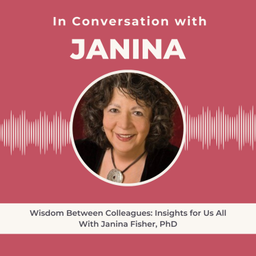
In this engaging episode of In Conversation with Janina Fisher, Janina sits down with clinical psychologist and psychodrama expert Dr. Tian Dayton to explore the power of experiential therapy—and why sometimes healing requires more than talking about what happened.
Tian introduces some of psychodrama’s most powerful techniques, including role reversal, doubling, and the empty chair, and explains how they can help clients move from talking about a relationship or experience to engaging with it in the present moment. By stepping into another perspective, clients may discover feelings, insights, and possibilities that weren’t accessible through the familiar story alone.
Janina and Tian explore the difference between repeatedly retelling painful experiences and revisiting them within a safe, supported therapeutic environment. Rather than remaining trapped in the role we have always occupied, experiential work can interrupt old narratives, bring the body into therapy, and allow emotions such as grief or anger to be felt and move through us.
Their conversation also explores the healing potential of groups, co-regulation, grief work, and the simple but powerful experience of encountering another person rather than remaining alone with our internal world. Tian shares how psychodrama and sociometry can create connection through shared experience, allowing group members to become therapeutic resources for one another.
Ultimately, Janina and Tian arrive at something larger than any one therapeutic method: healing is not a destination. We don’t finish our healing once and for all, and we don’t need to wait until some future moment to finally be “there.” Growth happens through experience, relationship, practice, and learning to return again and again to the present moment.
Key Takeaways:
Telling the story isn’t always the same as healing from it
Psychodrama helps clients move from talking about an experience to engaging with it
Role reversal can open perspectives that talking alone may not reach
The body and emotions need a place in therapy
Groups can become powerful sources of connection and co-regulation
Experiential work can be especially powerful for grief and unresolved relationships
Healing isn’t something we finish—it’s an ongoing process
Sometimes the most powerful therapeutic interventions are also the simplest
About Tian Dayton
Dr. Tian Dayton is a clinical psychologist, internationally recognized expert in psychodrama, trauma, addiction, and Adult Children of Alcoholics, and the author of numerous books on trauma, recovery, relationships, and experiential therapy.
A board-certified trainer in psychodrama, Tian has spent decades bringing psychodrama, sociometry, and experiential approaches into trauma and addiction treatment. She taught psychodrama at New York University for eight years and has trained generations of clinicians in methods that engage not only the thinking mind, but the body, emotions, relationships, and lived experience.
Her work includes the development of Relational Trauma Repair (RTR), an experiential model integrating psychodrama and sociometry with contemporary understandings of trauma and relational healing.
Tian’s Website:
https://www.tiandayton.com/ (https://www.tiandayton.com/)
Books by Tian Dayton:
Growing up with Addiction: How Adult Children of Addicts Can Heal Family Trauma, C-PTSD, and Codependency
https://www.amazon.com/dp/1785046497?lv=shuf&channelId=500&plpRedirect=mhFallback# (https://www.amazon.com/dp/1785046497?lv=shuf&channelId=500&plpRedirect=mhFallback#)
Other books can be viewed at author’s website:
https://relationaltraumarepair.com/endorsements/ (https://relationaltraumarepair.com/endorsements/)
The Living Stage: A Step-by-Step Guide to Psychodrama, Sociometry and Experiential Group Therapy
Sociometrics: Embodied, Experiential Processes for Healing Trauma and Addiction
The ACoA Trauma Syndrome
Emotional Sobriety
Trauma and Addiction
The Soulful Journey of Recovery
Treating Adult Children of Relational Trauma